
From cycle mechanic to landscaper with a passion for nature
10/11/2026 - 08:41
Some careers don’t follow a straight path. Thierry Pletinckx started out as a butcher before turning his passion for cycling into a career as a cycle mechanic, a job that took him around the world. Eventually, he found his true passion in landscaping. Today, through TP Tuinen, he creates lawns, gardens and planting schemes guided by a clear philosophy: work with care, never compromise on quality, and respect the living environment.
Thierry Pletinckx has a genuine passion for all things green. After years in the cycling world, he found his true calling in landscaping, particularly working with trees. We sat down with him to talk about craftsmanship, quality and the products he trusts.
| Interviewer: Davy Ottevaere |
Hi Thierry. Thanks for having me. Do you remember how we first met?
Of course. It was at Nationale Grasdag in Pittem, Belgium, last year. You introduced me to the TerraCottem products there. I also entered your competition and won one of the TerraCottem footballs (laughs).
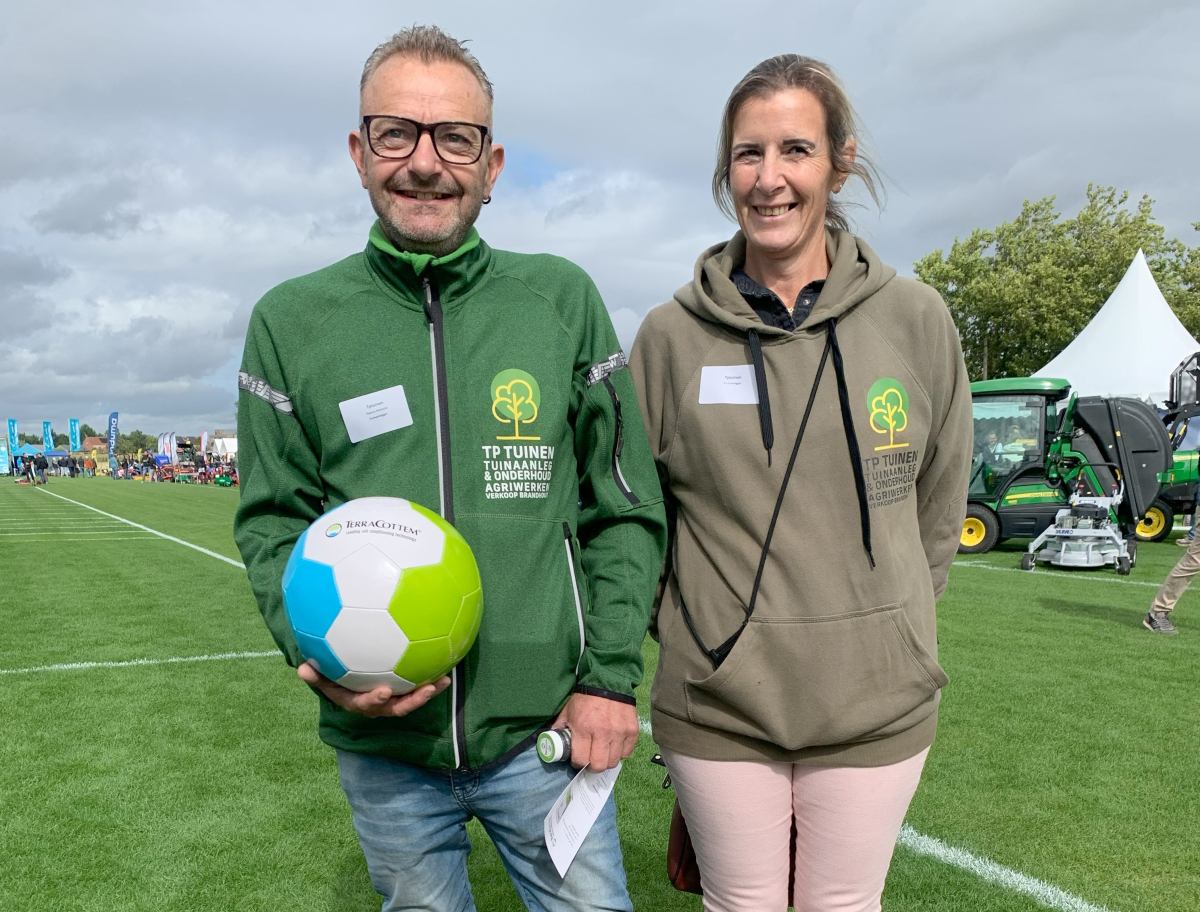
Exactly! And I see you’ve still got that football (laughs). I’m glad you could make time for a chat. Let’s start at the beginning: how did you get into this line of work?
It’s actually quite an unusual story (laughs). Although my parents worked in agriculture, I trained as a… butcher. When I was still at school, taking over the family farm didn’t seem like a realistic option, as it would have required a huge investment.
I wanted to go to agricultural college myself, but my dad said: “You need to learn a proper trade”. So I went – actually against my will – to CERIA in Brussels. I just about scraped through and got all my qualifications (laughs).
Once I’d graduated, I did work as a butcher for a while. But to be honest, I never really liked it…
Then I was given a unique opportunity to turn my passion for cycle mechanics into a career. Hilaire Van der Schueren, team manager of the WorldTour team Wanty-Groupe Gobert, lives nearby, and it was through him that I became more involved in the cycling world.
It was a fantastic time. I travelled all over the world — China, Dubai… there was always another adventure.
I also had the chance to be part of Victor Campenaerts’ successful hour record attempt. He was a regular visitor here. And I worked with Mark Cavendish for years. When he retired from racing, he gave me his bike as a gift. It’s still hanging here at home.
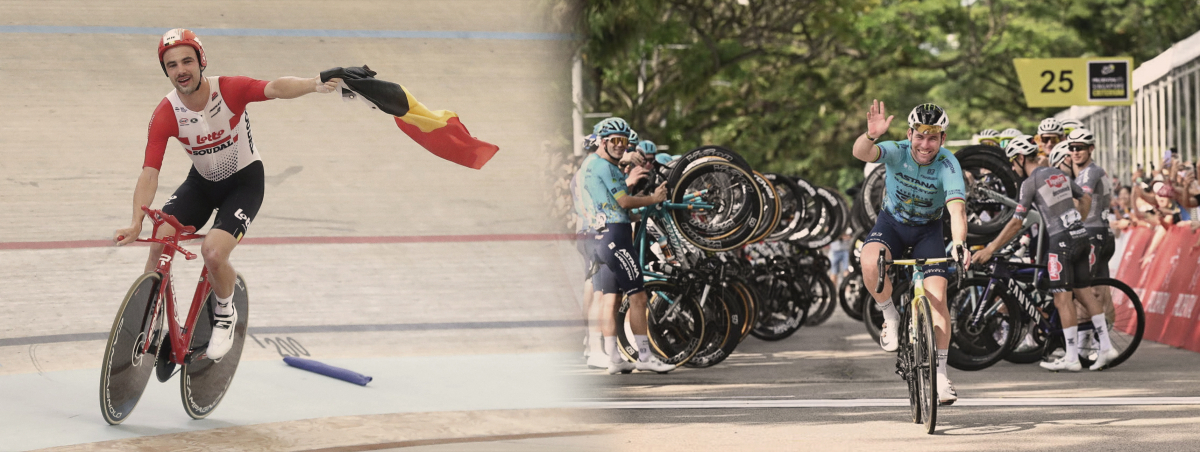
I’ve also done all the Grand Tours: the Tour, the Giro, the Vuelta… Absolutely all the major races. Once again: a real dream job!
Do you know what my favourite race was?
Tell me…
The Tour of Norway! What an incredible country. You really have to see it for yourself. My wife and I have even talked about moving there one day.
If you’re looking for peace, quiet and unspoilt nature, Norway is hard to beat. You can see wild salmon in the rivers, then there are the fjords, the reindeer… It’s magnificent. If you ever get the chance to go there on holiday, do it!
I can tell you’ve fallen in love with the place (laughs). And I can see a Norwegian flag hanging here in your house too.
That’s right. But getting back to cycling… the downside was that I spent more than 200 days a year away from home. In the long run, that simply wasn’t sustainable for my family. I still miss it every day, though. When the Tour of Flanders comes around, for example, it still tugs at the heartstrings.
So it was time to find something a little closer to home (laughs). With my background in agriculture and my interest in all things green, I started looking for opportunities in the landscaping sector. I came across an advert for Krinkels and decided to go for it. It turned out to be a great move. I worked there for around seven years and absolutely loved it, eventually working my way up to foreman.
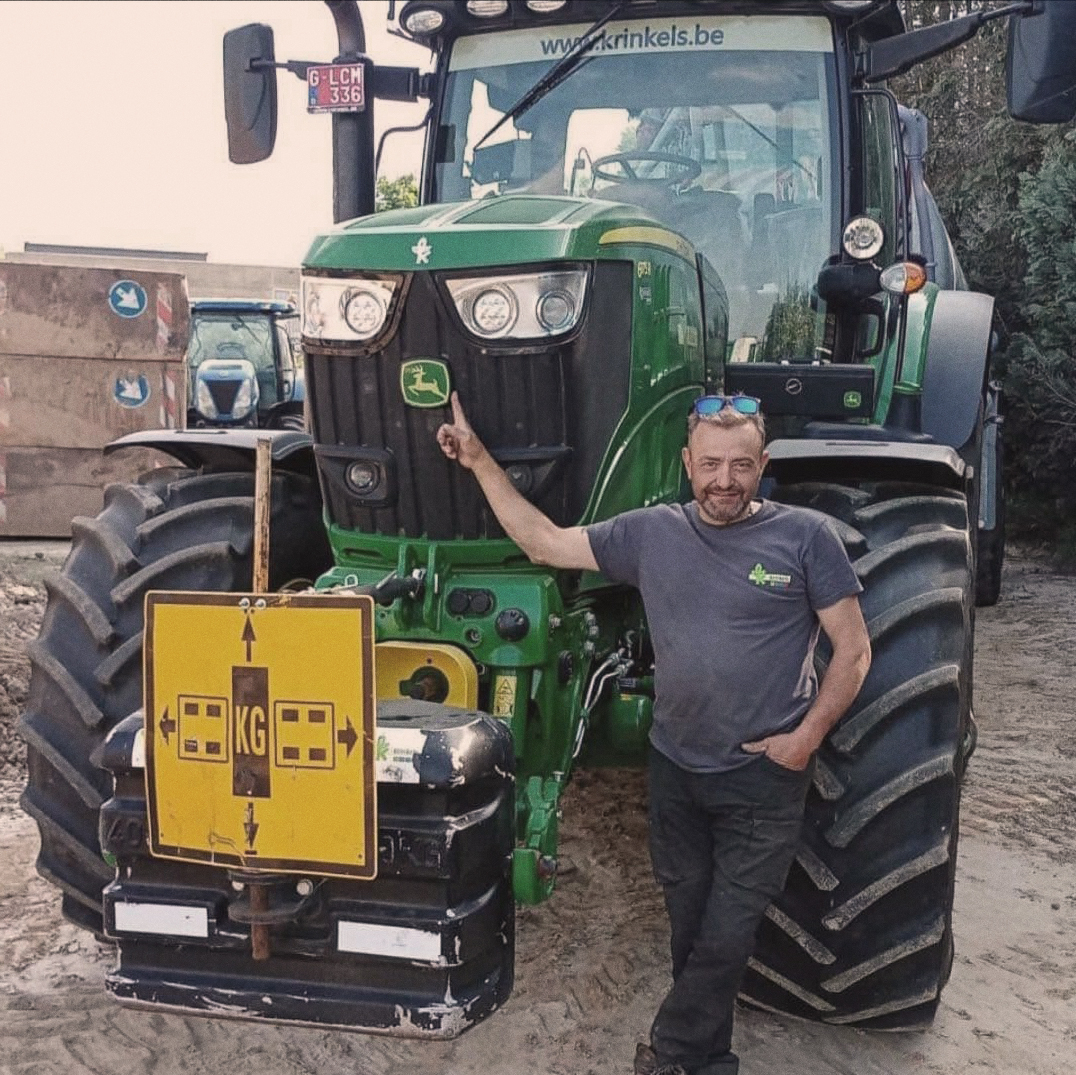
But then, unfortunately, I started having serious back problems. I’ve since had six back operations and now have a neurostimulator. The doctor wanted me to take medical retirement, but at 52 I wasn’t ready for that.
In the end, I managed to reach a kind of ‘Belgian compromise’ (laughs): I could continue working 25 hours a week. In practice, though, that was very difficult to combine with my responsibilities as a foreman, so I decided to become self-employed.
But you’re still able to work?
Absolutely. Fortunately, I know my limits very well. Being self-employed means I can organise my work more flexibly and alternate physically demanding jobs with lighter tasks, such as maintaining the machinery.
My customers are very understanding about it too. Luckily, because I’m not someone who can sit still for long — paperwork, for example… I hate it (laughs).
And how long have you been self-employed now?
Actually, this is my first year working full-time. But before that, I’d already been doing it part-time for five years. My diary is also very full: I’m completely booked up right up until my holiday. And actually, I don’t really take any holiday (laughs).
What sort of work do you do as a landscaper?
A lot of lawn installation, but also planting schemes with trees, shrubs and flower beds. I also take on some small-scale agricultural work, such as flail mowing, as well as pruning and felling trees, either turning the wood into firewood or chipping it. I do quite a bit of mowing too, for local councils for example, so I’ve invested heavily in machinery.
In fact, I enjoy pretty much anything that involves plants and green spaces. I used to do more hard landscaping too, such as patios and fencing, but I find that less rewarding, and sometimes it’s simply too physically demanding. I still take on the occasional small patio, of course, but planting is really where my heart lies (laughs).
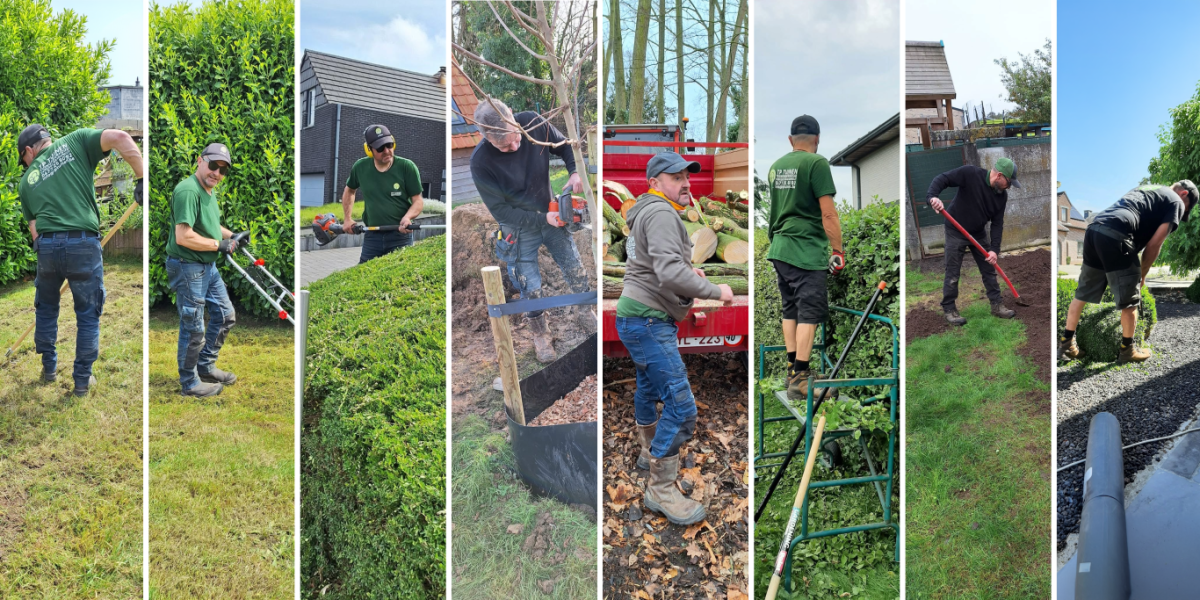
My dream is to specialise in the maintenance of football pitches. I love getting a pitch in tip-top condition, ready for play.
Do you work entirely on your own?
For the most part, yes. I handle most things myself. On larger projects, I sometimes team up with a local colleague. Often it’s simply practical: he has machinery that I don’t, and vice versa, so we help each other out.
If I’ve got a project with a lot of hard landscaping, for example, I’ll give him a call. We divide the work between us: I take care of the planting and other soft landscaping, while he handles things like fencing. And it works both ways — if he has a large hard landscaping project that also needs planting, he’ll call me in.
That sounds like a great and efficient way of working together…
Absolutely. In fact, I always say: ‘I’ve only got one competitor, and that’s the one up there’. If He says we can’t work today, then we don’t work (laughs).
Everyone else is a colleague, not a competitor. Of course, we sometimes find ourselves quoting for the same project — sometimes one of us gets the job, sometimes the other. But there’s plenty of work to go around.
Let’s go back to your early years: as a trained butcher… where did you pick up all your knowledge about landscaping?
Mainly through self-study and work experience. Because I was interested in landscaping, I researched a great deal on my own. At home, on my computer. I spent many hours poring over things. And, of course, I gained a huge amount of work experience at Krinkels.
Isn’t teaching yourself all this quite a challenge?
It is, but I absolutely love it. In my spare time, I’ll happily spend hours at the computer. There are so many good websites where you can find useful information.
I also like bouncing ideas off my youngest son. We’ll talk things through: ‘I’d do it this way — what do you think?’
Are your sons in the industry too?
Yes and no. My eldest son has gone down a different path and is a manager at a Colruyt supermarket in Lede. My youngest studied garden and green space management in Ghent. After graduating, he worked at ABOG. But he’s since become a site manager at a Krinkels subsidiary, Greencare. So he’s an ideal sounding board for me (laughs).
I can see some sketches lying on your table here too. Do you design gardens as well?
That’s the plan, anyway. For the time being, I’m doing what I can with some hand-drawn sketches and a free drawing programme on my computer, but the plan is actually to develop my skills further through evening classes soon.
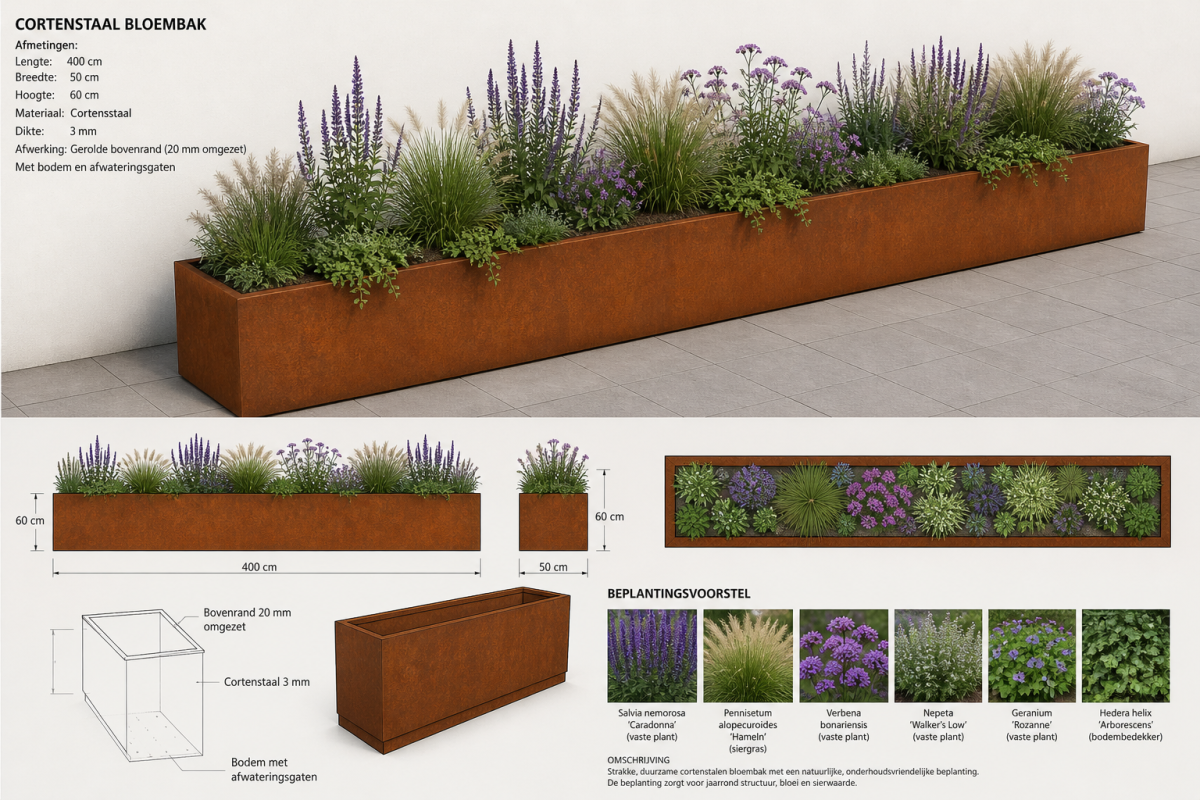
But I do take on that kind of work. Take these sketches here, for example… I was asked to design the planting for these steel planters, with an original planting scheme. The clients had already approached four other garden designers, but each of them had said they didn’t take on that sort of project.
It immediately caught my interest. This is exactly the kind of work I love: researching suitable plants, experimenting with different combinations in the design software…
I was given free rein: the only restriction was that each planter had to have the same colour tone. This, for example, is my ‘purple’ design.
How did you first come across TerraCottem?
Through Krinkels. We used it there for our planting projects.
I’m also keen to learn more about how products work. I found your ‘TerraCottem principle’ really interesting. When I was still working part-time, I started buying TerraCottem myself from Habo and began using it myself.
And which TerraCottem do you use?
So far, I’ve only used TerraCottem universal for my lawns and plantings. And for the hedges, trees and shrubs, I use TerraCottem arbor.
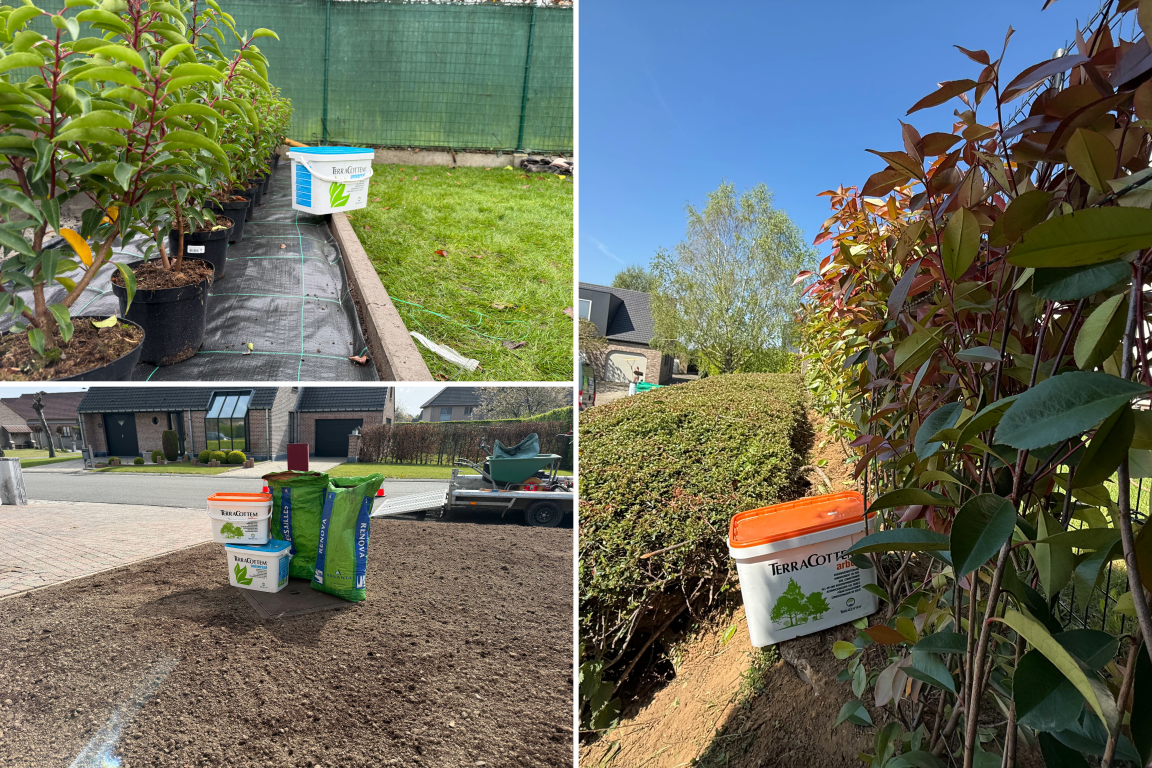
In the future, I’ll definitely give TerraCottem turf a go – you mentioned it during National Grass Day.
What appeals to you about it?
I like working with the best products — and, in fact, I only use products I can really rely on. I choose high-quality grass seed, good fertilisers and a soil conditioner that I know will perform.
That commitment to quality matters to me, and my customers know it. TerraCottem fits perfectly with that philosophy.
My customers know that when I landscape their garden, I use good topsoil, the best plants and high-quality products I have confidence in. When I’ve finished the job, it really has to be perfect. Only then am I proud to leave my nameplate there.
"I use TerraCottem for all my planting projects. For me, it’s the best choice because it delivers the results I’m looking for".
That’s lovely to hear…
… I’ll go even further: I’m also proud to be able to use such high-quality products. That’s why I recently decorated my stall at the annual fair in Herne, Pajottegem, with your promotional materials and others. People can – no, they must – know what I stand for!
"What I also really appreciate about you is that, as a company, you’re very approachable".
I noticed that at National Grass Day, where we had a very open and interesting conversation.
Thank you for your kind words…
Do you always buy your TerraCottem from Habo?
Yes, and lots of other products too.
And I usually get my planting stock from Willaert.
I was just about to ask you that (smiles). You do a lot of tree and shrub planting: what’s your key to success?
Last year, I got talking to the headteacher of BSBO De Drempel, a local school in Geraardsbergen. I’d noticed that some of the trees there weren’t developing properly. He asked me exactly the same question as you (laughs): ‘So what do you do differently?’
I told him that I always try to work to the highest possible standard and take the greatest care with my plantings. I put in a wooden frame and create a watering rim. I mix in TerraCottem. And I always work with plants that have a root ball.
The result was that I was allowed to replant 20–25 trees, and they’re all still thriving today! Not a single one has died, you know (proudly). Among other things, I planted some small fruit trees there. When I compare them with the four-year-old trees that were already there... In other words, the ones that had ‘survived’ the previous planting… my little trees were already producing more fruit after just one year!
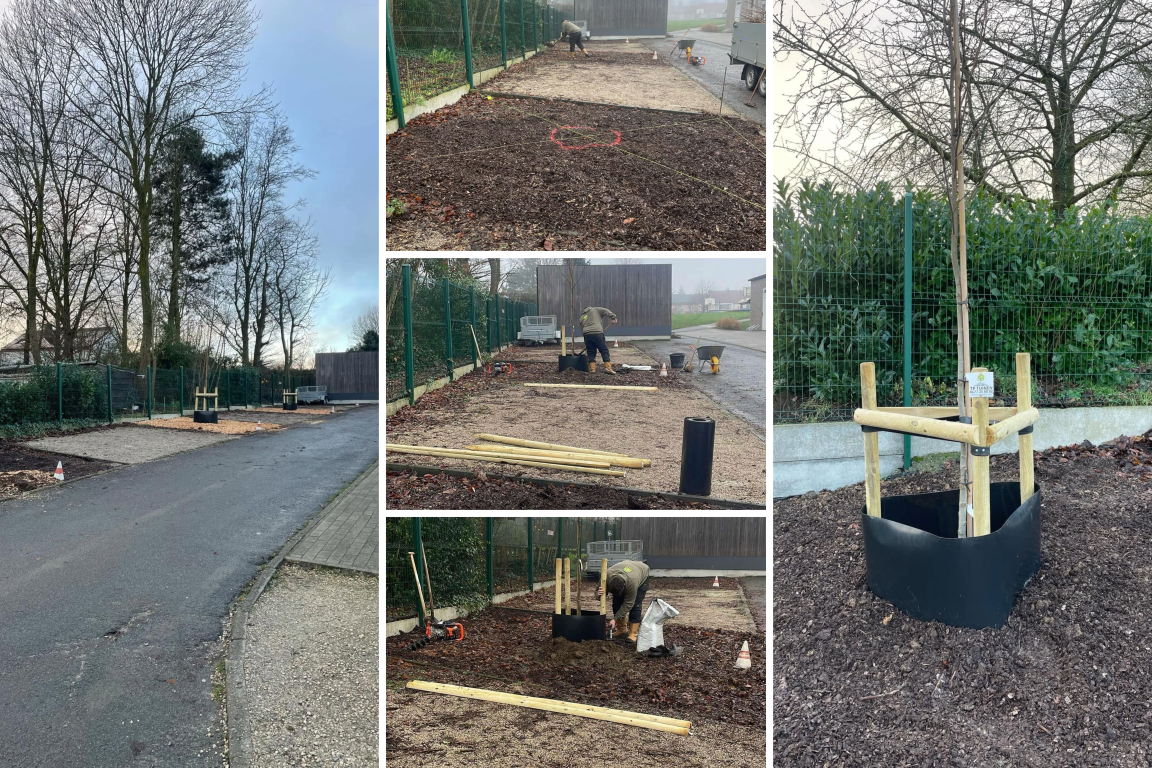
I also take care of the follow-up and maintenance. I make sure to visit at least once every three months to see how the plants are developing. I’ll remove weeds where necessary and check that everything is establishing properly.
Next year, the tree supports and concrete edging can be removed. I also give advice on things like watering during dry spells. I like to keep a close eye on all my projects, even after planting.
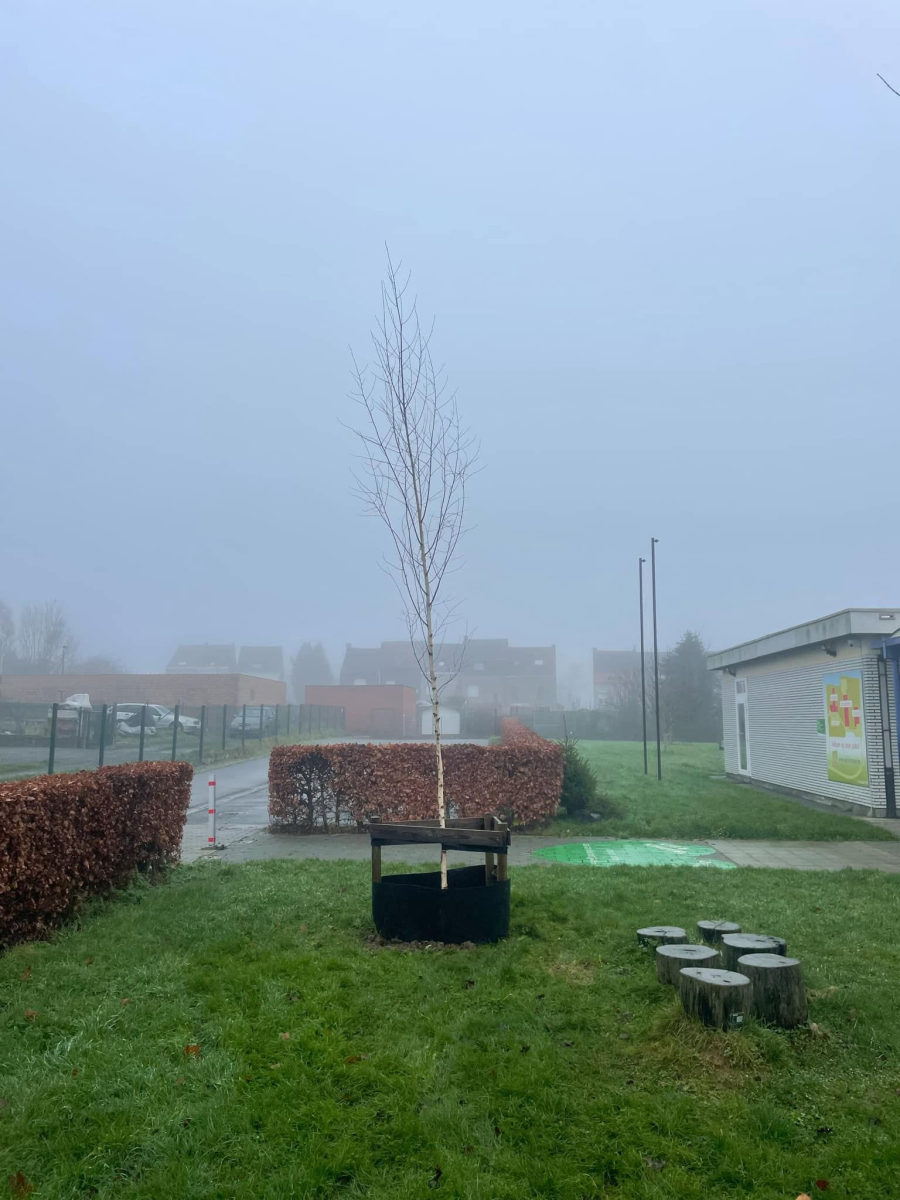
Trees are sacred to me. They are living beings and need looking after. Back when I was still working at Krinkels and trees needed planting, they’d call on ‘Thierry’ (laughs). Because even back then, they knew I’d put my heart and soul into the planting.
Sometimes when I see planting work… no watering basin, basins that are too small or poorly positioned, trees that aren’t properly aligned… it really bothers me.
What is your favourite tree?
All types of oak. But actually, I’m in love with plane trees. Their bark is phenomenal. And they also sprout beautifully.
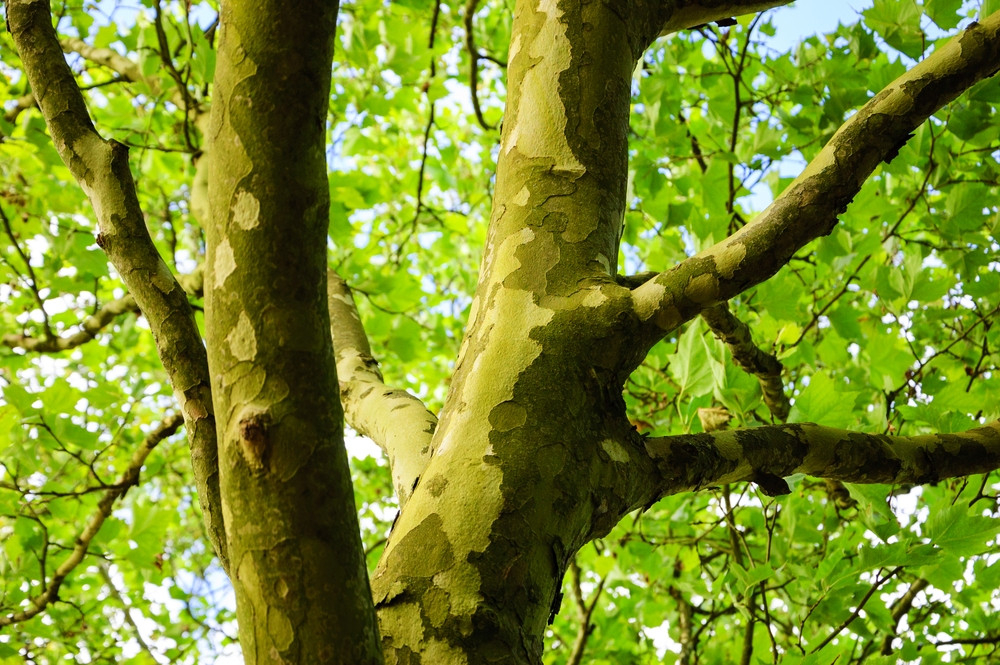
Thank you for the interview, Thierry. Do you have any questions for me?
Yes, just one (laughs). Can you confirm whether this is the correct way to mix TerraCottem into the soil?
- First, I remove the old lawn.
- Then I lightly till the soil.
- I add the topsoil.
- Next, I add TerraCottem and any other soil improvers if needed. To ensure everything is evenly distributed, I always use a fertiliser spreader.
- And then I work it all in evenly.
That’s perfect, Thierry! It’s important to incorporate TerraCottem evenly throughout the root zone, where it helps retain water and supports root development.
Now I know I’m doing it right (laughs).
"When I use TerraCottem, the grass really takes off. It comes up a rich, vibrant green — you couldn’t ask for better".
Want to find out more about TP Tuinen?
TP TUINEN
Thierry Pletinckx
Stikte 60
9500 Geraardsbergen, Belgium
T: 0477 25 60 92
E: Tptuinen@gmail.com
W: www.tptuinen.be
 |
If you know someone who might find this article useful, feel free to share the link.
Would you like to be in the spotlight too?
You can!
Send a quick email to marketing@terracottem.be and we will schedule an online meeting together.